The last time I seriously studied Mandarin was for 1 1/2 years in college. With my 15 year reunion coming up, that officially means I have since spent half of my life flailing to learn a second language.
However, over the past year, I have improved much more, and it’s all because of external motivation. My children had Chinese classmates, and they wanted me to speak more Chinese. One of my children also started at a Chinese immersion school, so I really needed to get going with it.
What didn’t work
Having spent many years not improving my Chinese proficiency, here are three things that didn’t work.
Watching TV shows in Chinese. Even when I watched children’s TV, the vocabulary gap is big. To make up the difference, I had to turn on subtitles, but then I was basically just reading the subtitles.
Listening to Chinese radio. Same issue, but I couldn’t even begin to understand what the topics were.
Duolingo and other apps. I wrote about this previously. I don’t blame the app developers because the premise and mindset is somewhat broken. Most language learning app users want to learn a language with just a few minutes a day, and that is just really, really hard. Learning anything hard should be time-consuming, and at least I was not exceptional to really benefit from it with my Chinese.
What would actually work
Before I start to sound like I have this figured out, let me disclaim by explaining how I’m clearly not willing to take this seriously.
Immersion. My excuse has always been that if I really needed to learn another language, I would. If I woke up one day and was stuck living in Taiwan, I’m certain I would figure it out much more quickly. However, I’m not willing to upend my life for that.
Tutoring. I also could be accountable to a real human being to learn and get regular, targeted instructions to learn. I’m also not taking it that seriously to build it into my schedule.
With that out of the way, I have worked in three different areas to improve my Chinese.
Vocabulary
I think the hardest part of learning another language is the vocabulary. If my grammar is bad, I can still piece together the words to be understood. If I’m speaking slowly or need things repeated, I’ll get through it. However, if I just don’t know what the word is, it’s really hard to get around that.
For learning vocabulary, I’m using two apps.
Pleco. When I first downloaded Pleco, it looked like a poorly designed Chinese dictionary. However, it also provides spaced repetition flashcards, so I have been aiming to get through 50 flashcards a day. I got the HSK packs for a more clear progression.
Google Translate. I worry too much about using the right word to not sound weird. For example, in English, someone would understand if I said “trousers”, but that would definitely be odd here in the US instead of “pants.”
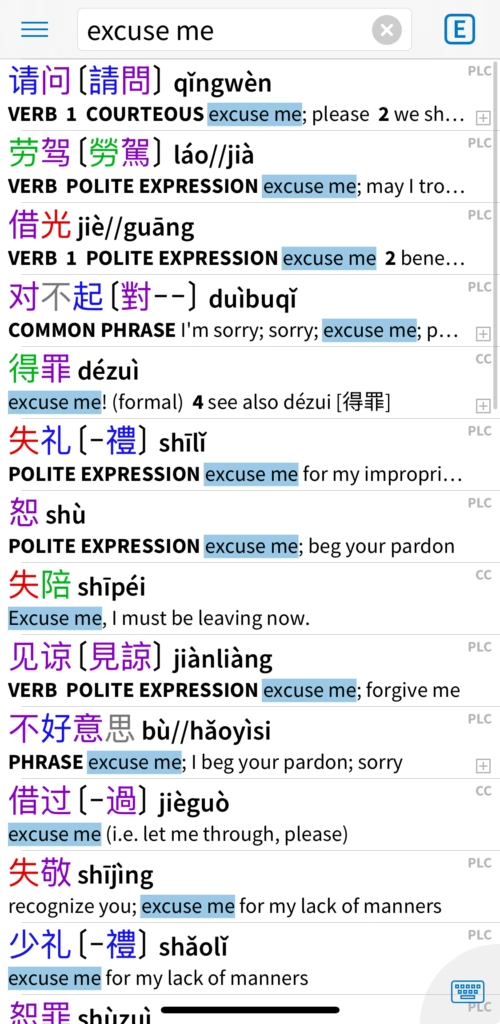
Unfortunately, Pleco doesn’t quite help me with usage. There are many ways to say “want” in Chinese. There are even many ways to say “excuse me.” And even “car trunk”. Google Translate helps me to pick the right words in context.
Listening
Comprehensible Input (CI). I struggled with TV shows and radio because they speak too quickly and use a lot of words I don’t know. At some point on YouTube, I discovered CI. At least as I use it, CI is an approach to language learning where I can listen to podcasts and videos specifically targeted at my level of proficiency. Thanks to the HSK system, this can actually be very closely targeted to a set of vocabulary. It provides a much clearer stepping stone for improving my listening.
In particular, I thank Lazy Chinese for getting me on the train. Prior to watching Suqing’s videos, I genuinely questioned if I would ever understand more than a sentence of basic Chinese at a time. Listening to and understanding clearly spoken Chinese in a podcast on a wide variety of topics actually gave me a lot of confidence that I could improve and should keep going.
Speaking
Talking to my children. The best part about talking to my children is that they don’t know any better, so I have no anxiety about making mistakes. I can try to say anything, then check Google Translate afterwards to see how wrong I was.
In general, it also helps that I speak relatively simply with my children. It’s a lot of basic commands. We don’t really have to talk about, say, international politics or technical details.
On the other hand, I didn’t learn much of this vocabulary in school. Mandarin in college seemed to care more about business vocabulary like “taxi” or “beer.” I care more about “socks” or “bath time.”
Talking to AI. The goal of all of this is to have real life Chinese conversations, and I’m still not confident with that. However, Gemini Live can be a pretty good conversation partner. I’m certain that an actual Chinese speaker would quibble with the details. However, at my level, it’s really useful to be forced to listen, react, generate, and speak Chinese in real-time. With the right prompt, Gemini will also correct me.
It doesn’t beat a human tutor or speaking partner, but it is very convenient and doesn’t induce anxiety.
Final thoughts
I mentioned at the beginning that one of my children is now at a Mandarin immersion school. Leading up to their first day, I was a little nervous for them: transitions are tricky even when it’s in the same language.
For them, I in retrospect should never have been worried. They did great. However, I realized that I was nervous for myself. I wanted my Mandarin to be better to speak with the teachers. Of course, they are very understanding and accommodating, but this was the real test for how well I had studied. No matter how many Duolingo lessons I had aced or flashcards I had completed, what really mattered was whether I could hold a conversation or not.
In deciding to place our child at this school, the biggest factor was convenience: the location is much, much better for my commute.
The next factor was the quality of education. The director is great at sales with a strong pitch on the teaching methodology. When we did our tour, it was evident how engaged the teachers and students were. Regardless of the language, we felt like it was a great school.
But the third factor here is my regret. I regret that I have never applied myself to learn a second language. Enrolling my child at this school was perhaps a way to fix that problem for them in an entirely natural manner.
But this is also an opportunity for me, too. It’s my chance to have a real reason to learn, so I can speak with my child and with their teachers. Let’s see what I can learn in the next few years.